Advertisement feature  

Samurai culture and mountain mysticism in Japan’s undiscovered Tohoku

Travel to Japan’s northern region to see feudal era history and ancient spiritual practices brought to life.

Tohoku is the northernmost region of Japan’s main island, Honshu. It is a land of soaring mountains and harsh winters, of centuries-old feudal and religious architecture, and even older customs and beliefs. Long considered remote for much of its recorded history, Tohoku was ruled by powerful warrior clans who, with a watchful eye to the capital, oversaw their domains with a great deal of independence. As a result, Tohoku is Japan, but also very much its own region.

Here, palaces are scarce, even amongst ruins; instead there are castles and bukeyashiki, the estates that belonged to high-ranking samurai, the powerful class of warriors. Tohoku’s remoteness, and its dramatic topography, has also shaped its unique religious beliefs and spiritual practices—a tradition that continues today.

Gaze at the cherry blossoms in all their glory at Hirosaki Castle

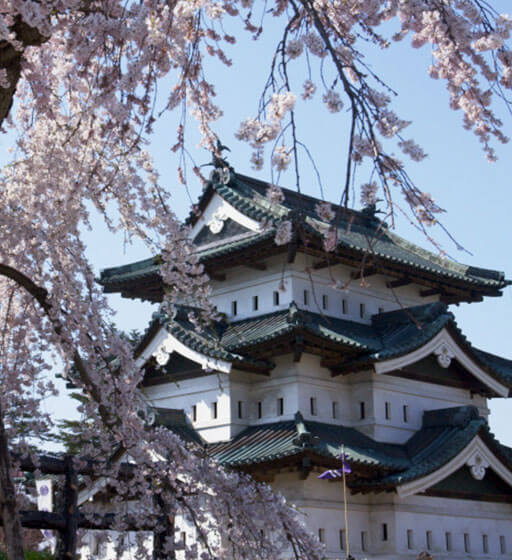
  • Hirosaki Castle was the seat of power for the Tsugaru clan, shrewd rulers who controlled much of present-day Aomori prefecture for almost three centuries. Built in the early 17th century, it’s one of only a dozen original castles still standing in Japan, and among the most beautiful. Its snow-white, three-storey main keep with tiers of sloping slate-tiled roofs, rises from a foundation of massive stones. After the feudal system was abolished in the late 19th century, the castle and its grounds were transformed into a public park. There is a wide grassy lawn and strolling paths over vermilion, arched bridges crossing the old castle moats. The castle keep is now a museum, with displays of samurai armour and arms.

    In 1903, over 2,500 cherry trees were planted on the grounds, which have turned Hirosaki Castle into one of Japan’s top cherry blossom viewing spots. People gather for picnics and take row boats onto the moat under outstretched branches. When the petals drop, they fill the moats, turning them blush pink and making the landscape look like it’s lifted from a fairy tale. The cherry blossoms bloom later in Tohoku, compared to destinations further west, like Tokyo and Kyoto; peaking usually between the last week of April and the first week of May. During these two weeks, the Hirosaki Park Cherry Blossom Festival is held and the castle’s cherry trees are lit up at night.

Step back in time in Kakunodate’s historic samurai district

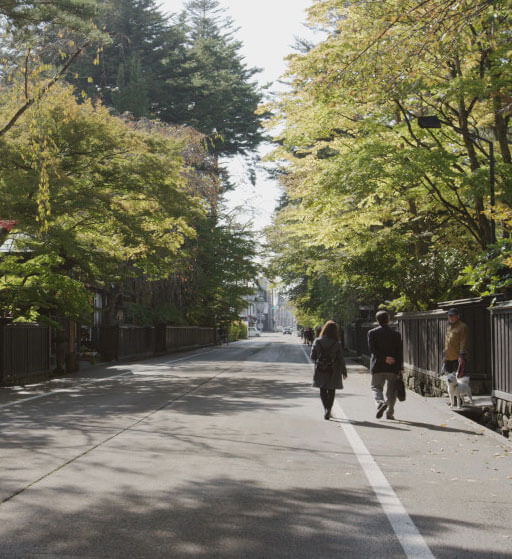
Like Hirosaki, Kakunodate is an old castle town—it just doesn’t have a castle anymore. What it has, instead, is one of Japan’s best-preserved feudal era townscapes. Kakunodate, in present-day Akita prefecture, was founded in 1620 and was ruled largely by the Satake clan. The highest-ranking samurai lived in estates called bukeyashiki. Constructed in the 17th and 18th centuries, the gated, dark wood manses that remain today are among the country’s best examples of architecture from that era. Half a dozen of these estates are now open to the public. Some are museums with artefacts that shed light on the lives of the landed and privileged in feudal era Japan, and others are left empty, which makes it easier to admire the woodwork.

  • Kakunodate, too, is known for its cherry trees: the samurai planted weeping cherry trees—whose tendrils reach over the walls of their estates—in their understated, manicured gardens. Elsewhere in town, along the Hinokinai River, more recently planted trees form a veritable canopy of pink on the riverbank. Like Hirosaki, Kakunodate hosts an annual cherry blossom festival, which sees the historic district’s trees illuminated after dark.

  • Cherry trees also played an important role in the local feudal era economy. Low-ranking samurai took up the craft of kabazaiku, making functional and decorative objects—like tea caddies and tobacco boxes—out of smooth cherry bark to supplement their income. The craft is still alive today, with gift shops in town carrying local artisan works.

Spend the night in a restored, traditional storehouse

Traditional Japanese architecture is made predominantly out of timber, which is why precious few original structures have survived to the present day. Storehouses, however, were designed to last: their timber frames were coated in clay to make them resistant to fire. A number of these structures, called kura in Japanese, can be found in Kakunodate’s historic district. And a few of them have been refashioned into boutique guesthouses under the moniker, Wanoi.

Each Wanoi property sleeps four to six, on raised beds or on traditional futon (floor mattresses) on tatami (woven reed) flooring. They have private baths with deep soaking tubs, and sitting areas with tables styled as irori, the central hearths that were once commonplace in Japanese homes. Upon request, traditional Japanese breakfast spreads made with locally produced rice and miso can be served in the rooms.


Immerse yourself in Tohoku’s spiritual side in Dewa Sanzan

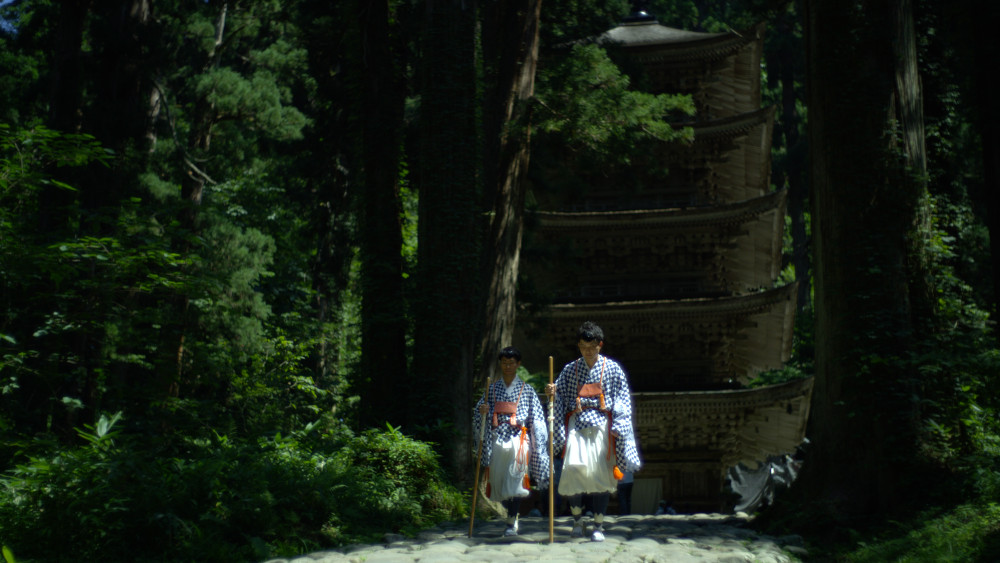
Hirosaki Castle and Kakunodate’s historic district are representative of Tohoku’s bygone feudal society. But the three mountains of Dewa—collectively known as Dewa Sanzan in present-day Yamagata prefecture—showcase a different aspect of Tohoku culture: its religious and spiritual traditions. For over a millennium, these mountains have incubated a mystical religion called Shugendo, which blends elements of Shinto, Buddhism, folk beliefs and mountain worship. It is an active practice: disciples, called yamabushi—who wear white robes and straw sandals now as they did then—practice austerities and symbolic rituals in the mountains.

At the base of one of the mountains, Mt. Haguro, stands the oldest wooden pagoda in Tohoku. Erected in the late 14th century, it’s believed to have replaced a pagoda that was first built in the early 10th century. The five-storey pagoda is made from local cedar, most impressively without a single nail, and stands 29m-tall in a wooded grove. From here, 2,446 stone steps, laid in the 17th century and worn with age, lead to the top of Mt. Haguro. This is the first leg of the three-peak pilgrim path through Dewa Sanzan—one that is equally popular with modern-day yamabushi and lug-soled, Gore-Tex–clad hikers. It’s also perhaps the most evocative and apt image of Tohoku, a place where ancient beliefs and practices complement contemporary ones, and where the past is never too far out of reach.

Produced by E² Studio for

Other Stories

Written by

BACK TO TOP